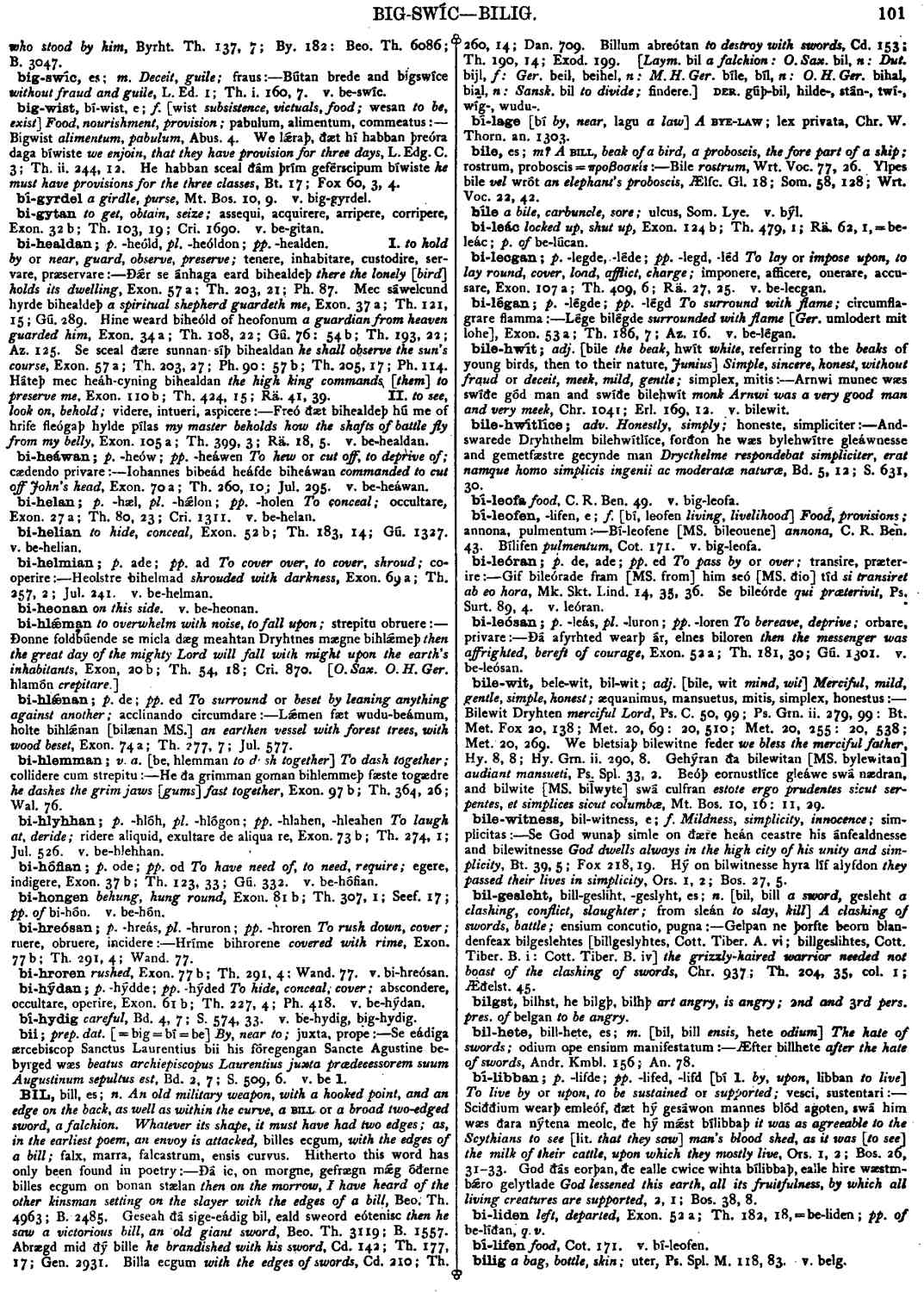
BIL
- noun [ neuter ]
-
Ðá ic, on morgne, gefrægn mǽg óðerne billes ecgum on bonan stælan
then on the morrow, I have heard of the other kinsman setting on the slayer with the edges of a bill,
- Beo. Th. 4963 ;
- B. 2485.
-
Geseah ðá sige-eádig bil, eald sweord eótenisc
then he saw a victorious bill, an old giant sword,
- Beo. Th. 3119 ;
- B. 1557.
-
Abrægd mid ðý bille
he brandished with his sword,
- Cd. 142 ;
- Th. 177, 17 ;
- Gen. 2931.
-
Billa ecgum
with the edges of swords,
- Cd. 210 ;
- Th. 260, 14 ;
- Dan. 709.
-
Billum abreótan
to destroy with swords,
- Cd. 153 ;
- Th. 190, 14 ;
- Exod. 199.
Bosworth, Joseph. “BIL.” In An Anglo-Saxon Dictionary Online, edited by Thomas Northcote Toller, Christ Sean, and Ondřej Tichy. Prague: Faculty of Arts, Charles University, 2014. https://bosworthtoller.com/4331.
Checked: 1